Comparing Real-Life Sports Strategies to In-Game Tactics
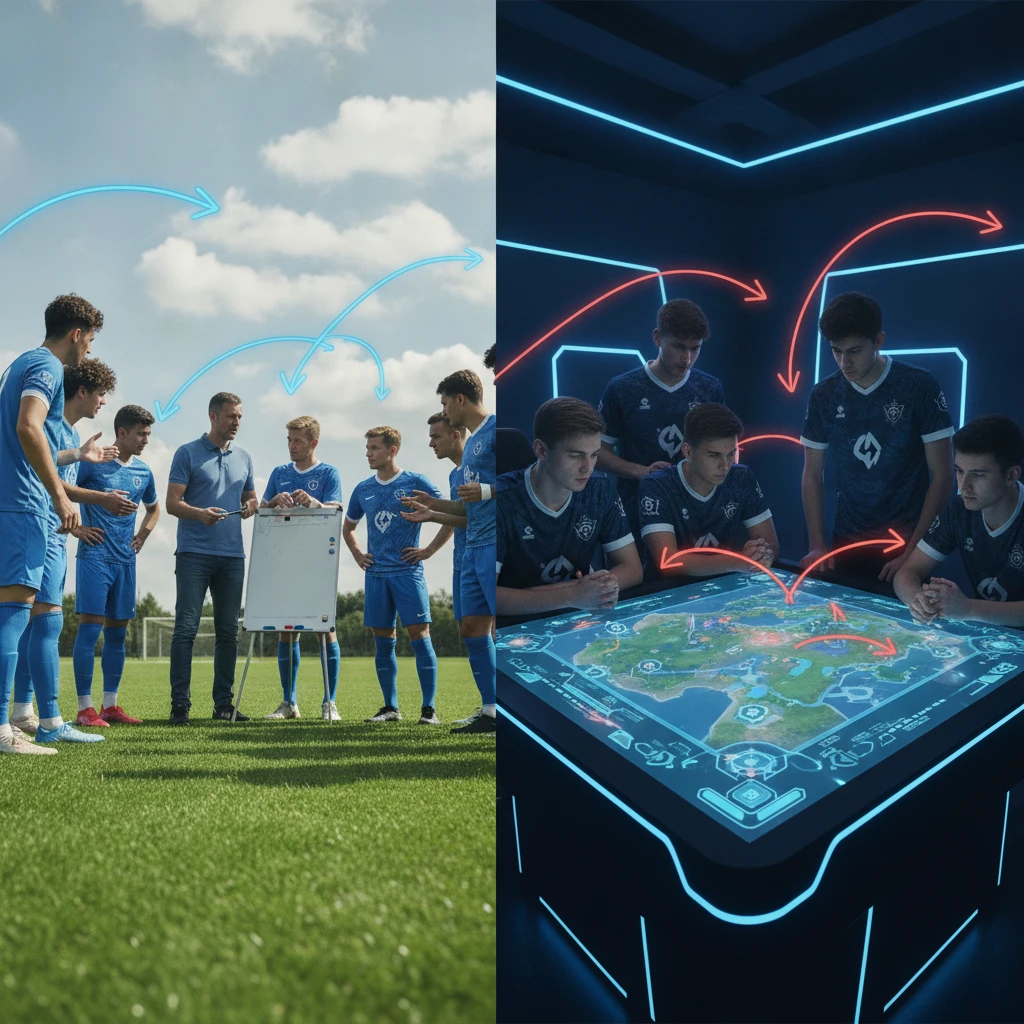
A basketball team creating space for a shot and an esports squad controlling a map may look like different worlds. Yet both rely on timing, positioning, communication, and decisions made with incomplete information. Comparing real-life sports strategies to in-game tactics can help players think more clearly, as long as they account for each game's rules and mechanics.
The useful lesson is not to copy a playbook wholesale. It is to understand why a tactic works, then test whether the same principle fits your game, role, and team.
What Strategy and Tactics Mean in Sports and Games
Strategy is the broader plan for reaching a goal; tactics are the specific choices made to carry it out. In real-life sports and esports, strategy sets priorities while tactics respond to what is happening in the moment.
A soccer team might choose to press high to win possession near the opponent’s goal. The decision to close a passing lane, shift the defensive line, or trigger the press after a particular pass is tactical execution. In a multiplayer shooter, a team’s strategy might be to control the center of the map; rotating together, holding an angle, or using an ability to clear a chokepoint are tactical choices.
The distinction works in solo games, too. A player may set a strategic goal to preserve health and reach a late-game objective. Choosing when to heal, which route to take, or whether to engage an opponent are tactics. Strategy establishes what matters; tactics answer what do I do now?
These terms can overlap in conversation, and the boundary changes with the time scale. A planned opening move can be a tactic within a larger strategy, then become the basis for a new plan when the opponent responds.
Shared Principles: Positioning, Teamwork, and Communication
Real-life sports and team-based games share three foundations: useful positioning, coordinated teamwork, and clear communication. These principles help people create better options and reduce the cost of mistakes.
Positioning is about being in a place that supports the next action, not simply occupying open space. In basketball, a player may move away from the ball to pull a defender out of the lane. In a tactical shooter, a teammate may hold a different angle so opponents cannot safely focus on one doorway. Both choices shape the opponent’s options before a shot or pass happens.
Teamwork connects those positions. A screen in basketball gives a teammate room to move; a coordinated ability combination in a game can open a route or force defenders from cover. Neither works reliably if teammates act on different assumptions. Communication helps align timing, targets, and fallback plans. A short call such as “rotate now” or “cover the exit” is more actionable than a stream of unprioritized observations.
- Support the next action: Choose positions that create a pass, crossfire, escape route, or objective play.
- Share the same timing: Coordinate when to engage, retreat, or use limited abilities.
- Cover gaps: Notice what the team cannot currently defend, then adjust roles.
These lessons apply most directly to team games. In a single-player game, positioning still matters, but teamwork and communication may become planning, information management, or choosing when to avoid a fight.
Reading Opponents and Adapting Under Pressure
Opponent analysis means using observed behavior to predict likely choices, then adapting your plan. In sports and esports, the best adjustment is usually based on evidence from the match, not on a guess about what the opponent “always” does.
A tennis player may notice that an opponent struggles when pulled wide and change shot placement. In a strategy game, a player might see repeated early aggression and invest in defense before expanding. In a team shooter, opponents who repeatedly rotate through the same lane may be vulnerable to a different setup. The common process is to observe, form a hypothesis, test it, and revise.
Pressure makes that process harder. People can overreact to one surprising play, chase a low-value fight, or keep using a plan simply because it worked earlier. A practical reset is to ask three questions: What did the opponent show? What resource did we spend? What is the next objective worth? This keeps adaptation tied to the situation.
Adaptability also has limits. Changing the plan after every small setback can create confusion, especially when teammates need time to reposition. Set a clear trigger for adjustments, such as repeated losses on one route or an opponent consistently using the same ability combination. Then communicate the change in one sentence and give the team time to execute.
Where In-Game Tactics Differ from Real-Life Sports
In-game tactics differ because each title has rules and game mechanics that shape movement, information, risk, and recovery. Real-life sports offer useful comparisons, but maps, respawns, abilities, and resource systems can make a familiar tactic behave very differently.
A physical athlete must manage fatigue, contact, and the limits of the human body. A game character may sprint, jump, or use an ability according to fixed cooldowns and movement rules. A map can funnel players through narrow chokepoints or provide sightlines that have no direct equivalent on a sports field. Learning those specific rules is part of tactical skill.
Respawns change the cost of a mistake. In a round-based game with no respawn until the next round, losing one player may sharply reduce the team’s options. In a mode with quick respawns, a risky attempt might be worth taking if it delays an objective. Neither situation maps neatly onto a sport where a player usually remains in play after a missed action.
Games also make resource management unusually explicit. Ammunition, cooldowns, energy, economy, and limited-use abilities can be tracked and timed. Spending a powerful ability to win a low-value encounter may leave the team without an answer at the objective. Conversely, saving everything for a perfect moment that never arrives wastes the resources too.
These differences explain why tactics cannot transfer perfectly. A real-world formation might inspire spacing, but the game’s map, character abilities, and victory conditions determine whether that spacing is useful.
How Real-Sports Thinking Can Improve Gameplay
Real-sports thinking can improve gameplay by teaching you to observe space, coordinate roles, and adapt to opponents. The transfer works best when you borrow a principle, then check it against your game’s mechanics.
Try this three-step filter before adopting a sports idea:
- Extract the principle: Identify what the tactic accomplishes, such as creating space, drawing attention, or protecting a teammate.
- Map it to the game: Find the equivalent in your title, such as controlling a sightline, baiting an ability, or covering a rotation.
- Test the cost: Check the time, position, and resources the tactic uses, and compare those costs with the value of the objective.
For example, a team might borrow the idea of a coordinated press: apply pressure together rather than letting one player engage alone. In a game, that could mean approaching from complementary angles after an opponent uses a key ability. But the team should first confirm that the map offers safe routes and that teammates can arrive at the same time. Otherwise, “pressing” becomes an isolated push.
One common mistake is copying a sports formation by name and assuming it will work. People do this because familiar labels make a plan feel complete. The consequence is often poor spacing or uncovered routes; instead, describe the job each role must perform and adapt it to the map. Another mistake is treating aggression as universal pressure. In games with costly deaths or long respawn timers, a patient hold may protect more win probability than an early fight.
Real sports can sharpen tactical awareness, but practice in the actual game remains essential. Mechanics, map knowledge, and timing are learned through play, not analogy alone.
Put the Comparison into Practice
To apply these ideas, review a match, identify one decision pattern, and test one change at a time. A small, observable experiment teaches more than changing several tactics at once.
After a match, choose a moment when your team lost an objective or gave up space. Reconstruct the sequence: where each player was, what information they had, which resources they spent, and when communication arrived. Avoid judging the play only by its outcome. A reasonable decision can fail, while a poor decision can occasionally succeed.
Then agree on one adjustment for the next session. For example: “If they take the center route twice, one player watches the flank while the others hold the objective.” Keep the call specific, name who is responsible, and decide what evidence would show the change is helping.
- Review one or two decisive moments rather than trying to analyze every action.
- Use short, consistent calls for opponent positions, rotations, and resource use.
- Test a tactical change across several comparable rounds before judging it.
- Keep the parts that fit your game and discard the sports analogy when its assumptions fail.
This process builds a bridge between real-life sports strategy and in-game tactics without confusing them. The goal is better decisions: understand the space, coordinate with your team, read the opponent, and let the game’s rules determine the final move.
Frequently Asked Questions
Which sports strategies translate best to esports? Principles such as creating space, covering teammates, timing coordinated pressure, and adapting to an opponent often transfer well. Their exact execution depends on the game.
How does positioning differ between a physical sport and a video game? Both use position to create options and limit opponents, but games add fixed maps, sightlines, abilities, and movement rules. Those mechanics can make a small shift in location especially valuable.
Can studying real sports help someone improve at games? Yes. It can develop awareness of teamwork, spacing, and opponent tendencies. It cannot replace practice with the game’s controls, maps, and resource systems.
Why don’t all real-life tactics work in-game? Games have different rules for respawns, abilities, objectives, and risk. A tactic only works when its underlying purpose fits those mechanics and the current situation.