History of Esports: From Arcades to Global Arenas
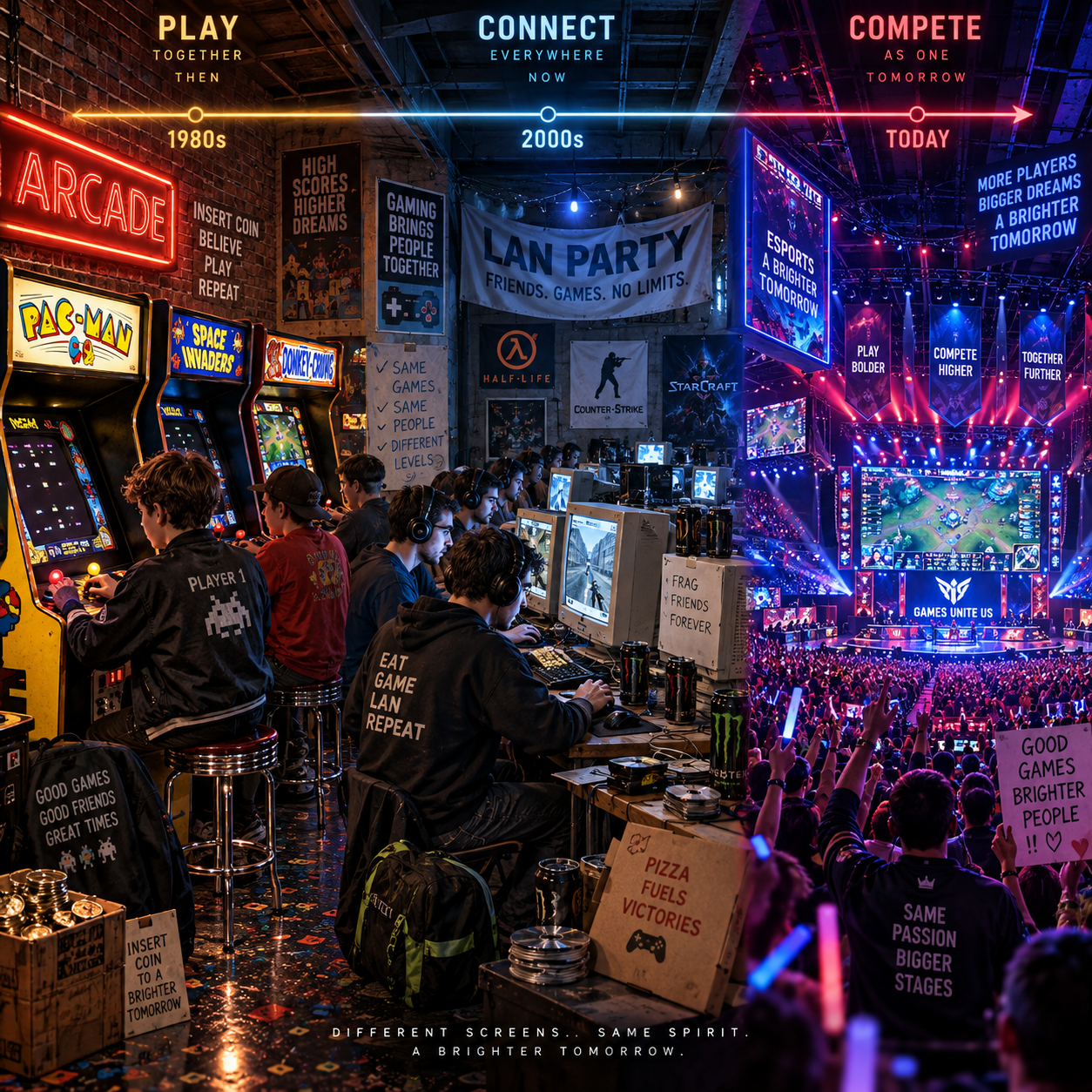
The history of esports is a story of technology, competition, and community. What began with players comparing arcade high scores gradually became organized video game tournaments, international leagues, professional teams, and sold-out arenas.
Esports did not develop along one perfectly straight path. Arcade gaming, home consoles, personal computers, LAN parties, broadband internet, livestreaming, and publisher-backed leagues each influenced competitive gaming at different times. Together, they created the modern esports ecosystem.
What Is Esports?
Esports is organized competitive video gaming in which individuals or teams compete under established rules, usually for rankings, prizes, league positions, or championships. Casual multiplayer can be highly competitive, but esports adds formal structures such as tournaments, referees, broadcast coverage, teams, and professional schedules.
The term covers many formats. A fighting game may feature one-on-one bracket play, while a game such as League of Legends uses five-player teams, coaches, seasonal leagues, and a world championship. Real-time strategy games, first-person shooters, sports simulations, and battle royale titles all contribute to the wider field.
This structure separates esports from simply playing a game well. A ranked match is part of a competitive environment, but a professional esports event also requires organizers, servers, rules, production crews, and a way for an audience to follow the action.
The Arcade Era and the First Gaming Competitions
Arcade gaming created the social and competitive foundation of esports by placing scoreboards, players, and spectators in the same public space. High-score tables turned individual performance into a visible challenge that anyone could attempt.
Early computer experiments such as Spacewar! demonstrated that digital games could support direct competition. In the 1970s, Pong made two-player electronic competition accessible to a mass audience, while arcade cabinets offered immediate feedback, simple rules, and repeatable challenges.
Space Invaders helped push arcade competition toward record chasing. Players returned to improve their scores, and public leaderboards gave skilled players recognition beyond their local group. This was an important cultural shift: the game became a shared contest rather than a private pastime.
Arcades also supplied something modern online games still depend on: a reliable meeting place. Players watched techniques, exchanged advice, challenged strangers, and developed informal reputations. Early video game tournaments grew from this environment, although they were generally smaller, less standardized, and less consistently documented than later esports events.
The limitation was scale. Arcade competitions depended on physical locations, machine availability, and local advertising. A player might dominate a neighborhood cabinet without having a practical way to compete with someone in another country. Even so, the arcade era established the basic loop of competitive gaming: practice, perform, record the result, and try to beat the next challenger.
Home Consoles, PCs, and the Rise of Organized Tournaments
Home consoles and personal computers expanded competitive gaming by moving games from public arcades into living rooms, dormitories, clubs, and dedicated computer spaces. This made repeated practice easier and allowed communities to organize events around shared equipment.
During the 1980s and 1990s, console competitions, local gaming gatherings, and magazine-sponsored challenges introduced more formal tournament structures. Players could compete in games such as fighting titles, racing games, and sports simulations without needing to visit an arcade. Organizers began using brackets, entry rules, scheduled rounds, and prizes.
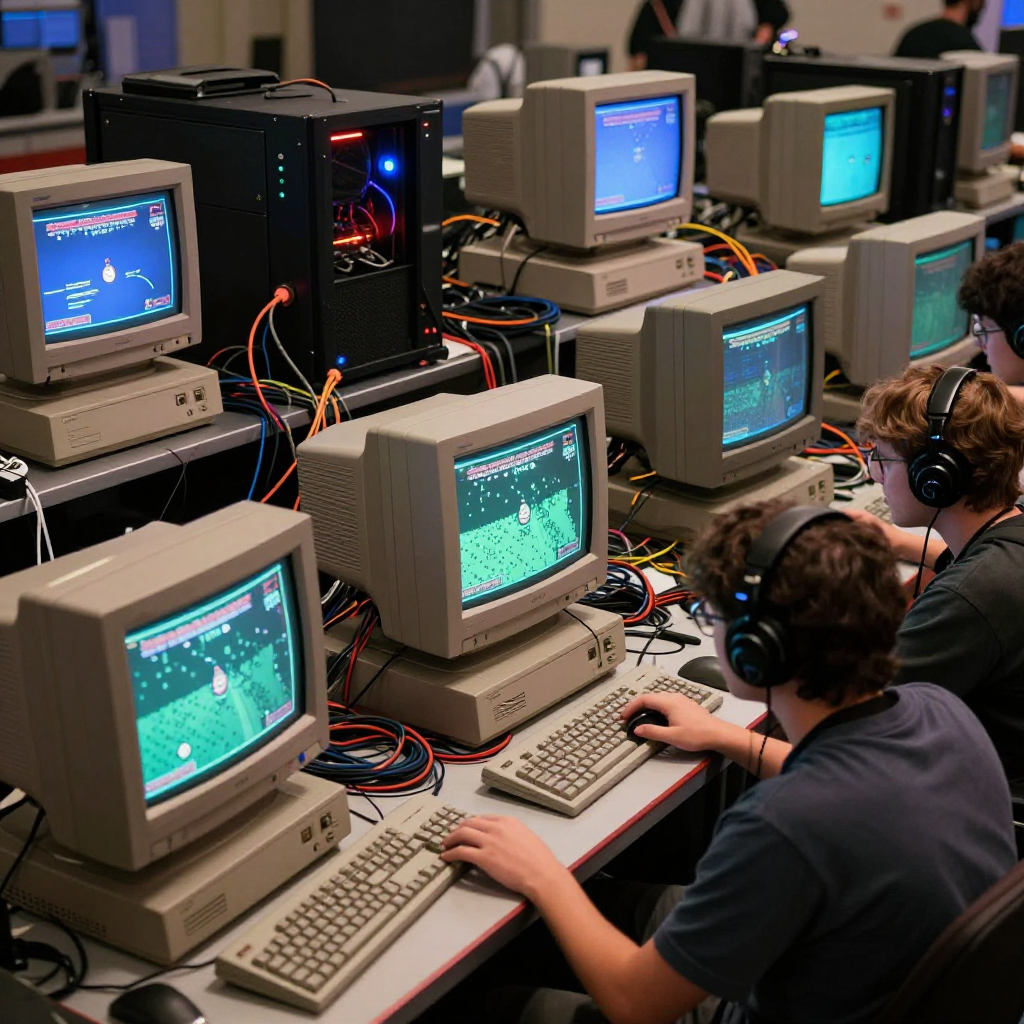
Personal computers brought another major change. A PC could support keyboard and mouse controls, deeper strategy systems, custom maps, and network connections. University networks, computer clubs, and local events became important testing grounds for competitive play.
LAN parties were especially influential. Players brought computers into one location and connected them through a local area network, reducing the connection problems that affected early online play. These gatherings combined competition with a strong social atmosphere: teams practiced together, spectators gathered behind players, and technical knowledge spread quickly.
LAN events also revealed a lasting trade-off. Local networks offered low latency and direct social contact, but they required travel, equipment, and considerable setup. Online play would eventually remove much of that friction, while losing some of the face-to-face energy that made early computer competitions memorable.
Online Multiplayer Transforms Competitive Gaming
Online multiplayer transformed esports by connecting players beyond local venues. Internet access allowed communities to practice, compete, and organize across cities and countries without meeting in the same physical room.
Games such as StarCraft showed how powerful online competition could become. Its demanding real-time strategy gameplay rewarded planning, speed, adaptation, and precise control. Online ladders gave players a way to measure themselves against a much larger field, while regional scenes developed around dedicated competitors and broadcasters.
Counter-Strike helped establish another influential model. Team-based tactical matches made communication, role specialization, map knowledge, and coordinated strategy central to success. The game grew through community servers, local competitions, LAN events, and later professional tournaments.
Internet competition changed the meaning of access. A talented player no longer needed to live near a famous arcade or tournament venue to find strong opponents. At the same time, online play introduced new problems, including unstable connections, cheating, server disagreements, and regional differences in infrastructure.
Matchmaking and ranking systems gradually made competition easier to enter. They also created a development ladder: a newcomer could play casually, enter ranked matches, join an amateur team, and potentially reach organized competition. That pathway became one of the defining features of modern esports.
Professional Esports Takes Shape
Professional esports emerged when competitive communities gained stable teams, leagues, sponsors, prize pools, and regular broadcast coverage. Players began treating practice, travel, contracts, and public performance as part of a career rather than an occasional hobby.
Organizers created recurring circuits instead of relying only on standalone tournaments. Teams adopted names, logos, coaches, analysts, managers, and training routines. Sponsors saw opportunities to reach young, digitally connected audiences, while game publishers recognized that organized competition could extend a title’s cultural life.
Different games developed different professional models. Some scenes were built around open tournament circuits, where many teams could qualify through regional events. Others moved toward publisher-controlled esports leagues with franchised or partnered teams, scheduled seasons, and centralized production.
This period also changed the role of the player. Mechanical skill remained essential, but professionals increasingly needed communication discipline, media training, travel stamina, strategic preparation, and contract awareness. Coaches and analysts translated large volumes of match information into practical plans.
Growth brought pressure as well as opportunity. Prize money and sponsorship increased the rewards for success, but careers could be short, workloads intense, and income uneven. A healthy professional scene needs clear rules, reliable event operations, player protections, and pathways for new competitors.
Streaming, Global Audiences, and Esports Arenas
Streaming made esports easier to watch and helped turn local competitions into global entertainment. Digital platforms allowed fans to follow matches live, interact through chat, and discover players without relying on television schedules or physical attendance.
Livestreaming changed the relationship between competition and audience. A tournament could now reach viewers in many time zones, while individual players could build communities through regular broadcasts. Commentary, highlights, social media clips, and creator content gave matches a longer life after the final round.
This expanded audience supported larger productions. Major events added broadcast desks, player interviews, statistical graphics, opening ceremonies, sponsor activations, and multilingual coverage. Esports leagues and global arenas began to resemble traditional sports events in presentation, even though the competition remained digital.
Modern arenas offer an experience that early arcade contests could not: massive screens, coordinated lighting, live commentary, merchandise, hospitality areas, and thousands of spectators sharing the same result. Yet the core remains familiar. Fans still gather to watch skilled players attempt something difficult under pressure.
The online model has limits. Streaming platforms can change policies, advertising markets fluctuate, and viewer attention is divided among many games. Physical arenas create atmosphere and prestige, but they also bring high production and travel costs. Successful esports events balance digital reach with a live experience worth attending.
The Modern Esports Ecosystem
The modern esports ecosystem is a network of publishers, teams, players, coaches, tournament organizers, platforms, sponsors, and fans. Each group contributes a different resource, and the scene works best when their incentives remain aligned.
- Publishers own or control the games, maintain servers, issue updates, and often license competitive circuits.
- Players provide the performance that attracts viewers, teams, sponsors, and community attention.
- Teams and coaches recruit talent, manage practice, develop strategy, and support player careers.
- Tournament organizers run brackets, rules, venues, broadcasts, refereeing, and event logistics.
- Streaming platforms and broadcasters distribute matches and help create regular viewing habits.
- Sponsors fund teams and events while connecting brands with esports audiences.
- Fans and communities supply viewership, discussion, fan art, attendance, and long-term cultural energy.
The ecosystem continues to evolve as new platforms, game genres, and international regions enter the picture. Mobile esports has widened participation in places where high-end PCs or gaming venues are less accessible. Collegiate and amateur competitions provide additional routes into organized play, while women’s leagues and community-led events continue to broaden representation.
Looking back, the progression is clear without being perfectly linear: arcade scoreboards created visible competition, home systems made practice more convenient, LAN parties strengthened communities, online multiplayer connected distant players, and streaming made the results globally watchable. Today’s global arenas are the latest expression of an idea that started with a simple question beside an arcade cabinet: who can play better?
Esports History FAQ
When did esports begin?
Esports began developing in the early era of competitive computer and arcade gaming, when players compared scores and entered organized video game tournaments. Its modern professional form emerged later through PC networks, online multiplayer, leagues, and regular broadcasts.
What was the first esports tournament?
There is no single universally accepted starting point because early competitions took several forms. Small arcade contests, computer gatherings, and organized events all contributed to esports history, so it is more accurate to view the first tournament era as a gradual development.
Which games helped popularize esports?
Spacewar!, Pong, and Space Invaders helped establish competitive arcade gaming. Later, StarCraft and Counter-Strike demonstrated the potential of online PC competition, while League of Legends helped popularize publisher-supported leagues and global events.
How did streaming change esports?
Streaming allowed fans worldwide to watch matches live, follow players directly, and interact with communities in real time. It reduced dependence on local venues and traditional television, helping tournaments build international audiences.
How are modern esports events different from early gaming competitions?
Modern events use professional teams, standardized rules, dedicated production crews, online distribution, sponsors, large prize structures, and global venues. Early competitions were usually local, centered on high scores or informal matches, and limited by the technology and reach of their time.